During my years as a photographer I have been fortunate enough to own and use many lenses from across different brands. By this I do not mean that I have had them for a few weeks simply for review purposes. Without exception I use all of my equipment for its intended purpose over long periods of time (although I have occasionally found myself with a closet queen or two).
The largest part of my camera collection are my lenses, and ownership of some stretches back decades. Camera bodies have come and gone, but many lenses tend to stick around longer.
 My ongoing scanning project reminds me how much I enjoyed using some of my old Olympus analogue lenses. This enjoyment came not only from using small precision made optics, but from the results garnered. Many were designed in the 1970’s and exhibit flaws that advancing technology has eradicated. Sure, most of them were sharp enough, but they had their share of aberrations that would make a modern day perfectionist squirm. As time passed, I unknowingly found myself chasing optical perfection that resulted in the use of some truly spectacular lenses that I could have only dreamed about decades ago.
Reviewing my older projects, there is no doubt that results delivered through some of these aging lenses had an almost unquantifiable appeal that is lacking in modern designs. My recent move into the Pentax DSLR ecosystem has brought this back under the spotlight once more.
Today, new Pentax lens releases are few and far between. Those that are released (such as the DFA* 50, 85 and 70-200) are spectacular and amongst the most optically perfect lenses I have ever used, giving some of my Leica optics a run for their money.
Pentax also has a ‘Limited’ line of lenses that have been created with a completely different ethos which emphasises experience over optical perfection. Small, well made and beautiful to handle, the Limited series are hand built from premium materials. Similar to Leica M lenses, they cry out to be picked up, handled and used. My use of Ethan’s FA 31mm Limited lens has reminded me so much of my old film lenses and not just in handling. The results are much more ‘organic’ and, for want of a better adjective, ‘flawed’. Aberrations such as vignetting, spherical, coma, chromatic (lateral and longitudinal) leave their mark but not to the detriment of the final image. Like my old film lenses, the 31 needs stopping down a little to achieve maximum sharpness, particularly in the corners. But at wider apertures a certain magic happens. Some Pentaxians refer to this as ‘Pixie Dust’, the exact definition of which is very difficult to define and means different things to different users. However, many agree that a certain ‘je ne sais quoi’ is going on that is possibly linked in part to the aberrations accepted as part of the design. Compromised in a most positive and appealing way is how I see them.
Limited lenses have their roots planted in the very late 1990’s when film was popular and digital was in its ascendancy. Part of the design philosophy was that emphasis on optical correction was made not so much by MTF curves but by human sight that paid particular attention to bokeh, contrast and sharpness. The result is a much less clinical appearance to images. In the following decades, the FA limited lenses achieved almost cult status and have remain in Pentax’s current line up with very few changes being made to them.
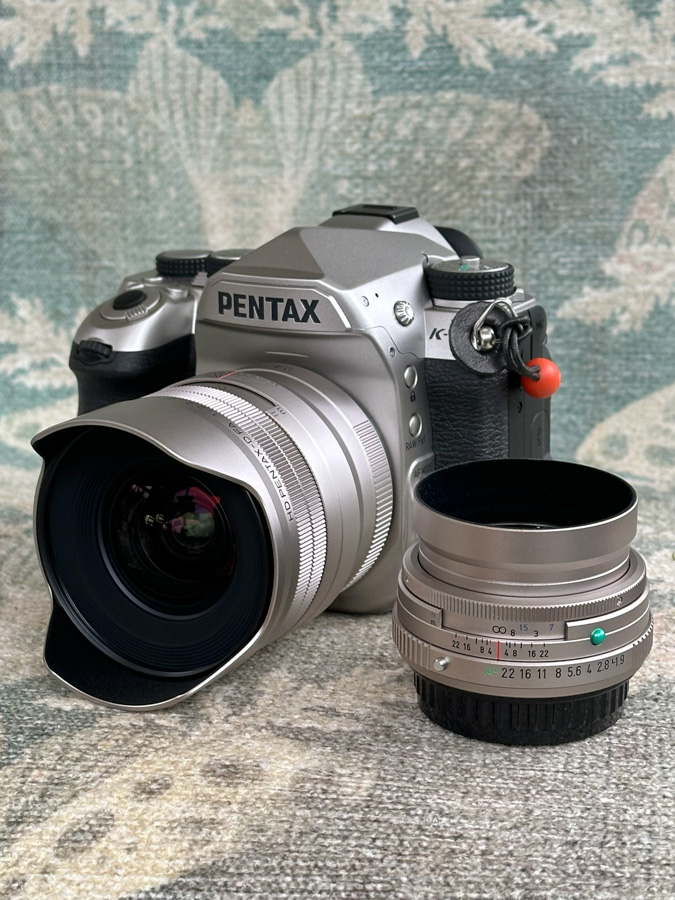
The time I have spent with Ethan’s FA 31 has made me realise how special this lens is, and led to me taking a look at it’s siblings, notably the FA 43 and DFA 21. As these represent the very first and most recent (DFA 21), I thought it would be interesting to see how the Limited DNA has transcended the decades. At the point of writing the only use they have seen is to adjust focus calibration. Looking ahead, I am hoping that I can get back something of what I feel is lost when using modern designs.
Physically, both lenses look and handle beautifully and it is obvious they share the same pedigree. Evolutionary differences of the 21mm are sympathetic to the original design concept. The DFA 21mm f2.4 introduces the following key changes over original FA Limiteds;
- Larger Size
- Environmental Sealing
- Quick Shift Focussing
- Quiet DC Autofocus Motor
- No Aperture Ring
Of course the ultimate test is how they perform optically, and spending time with them in the coming months is something I am really looking forward to. For now, all of my other lenses will will be parked while I get a better understanding of the Limited design philosophy that will hopefully reward me with some of the magic that these legendary lenses are renowned for.