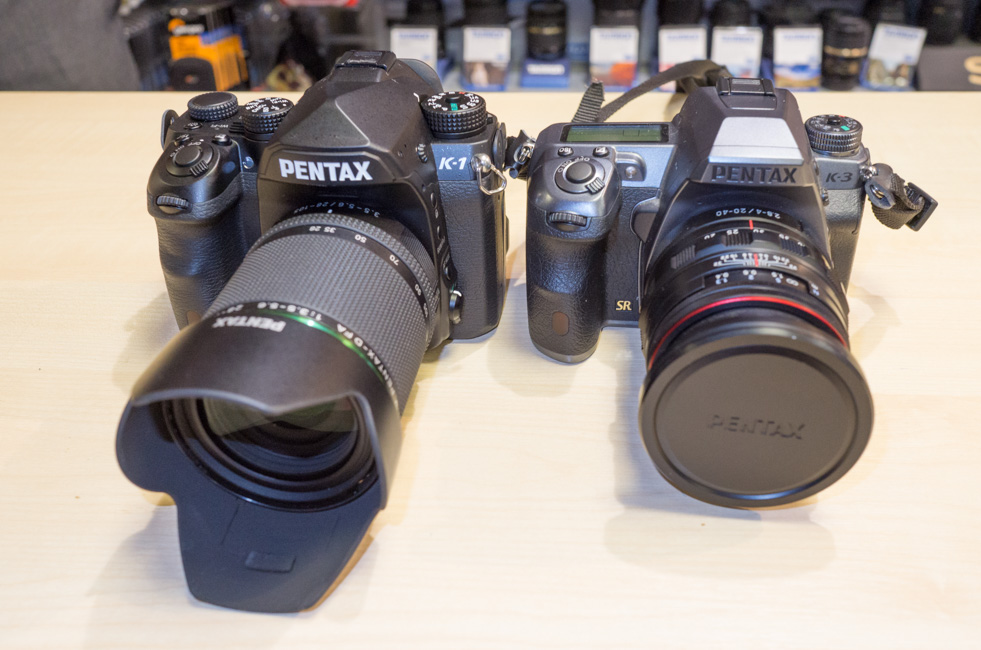
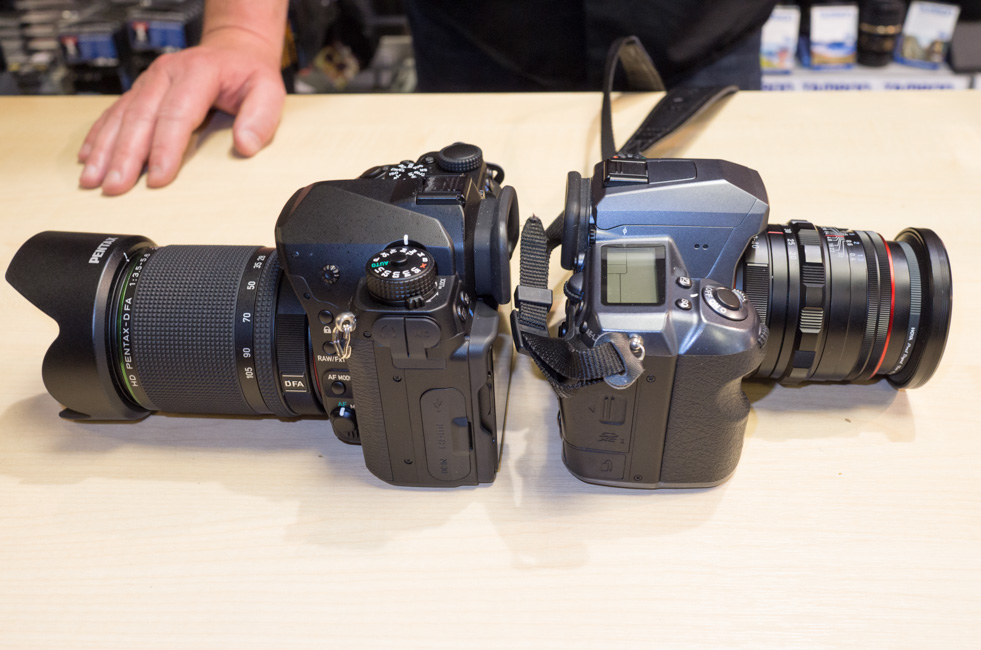
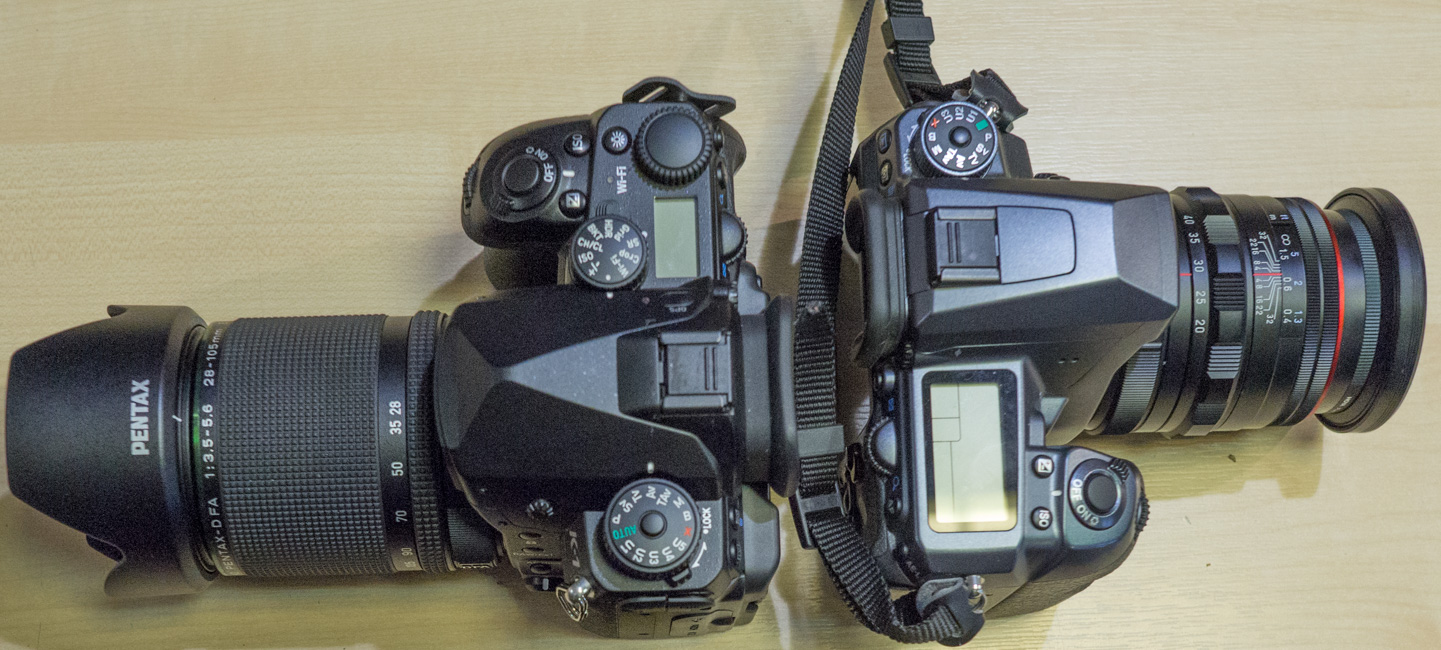
For many years rumours of a ‘full frame’ DSLR have reverberated around Pentax forums, the spectre of which carried no real substance until around twelve months ago, when mock up models began appearing at camera shows. However if we take a look back at Pentax’s history it appears that myth is based on fact, and that around 15 years ago a 6mp model was created but was not released due to sensor and other technical issues. I find this typical of Pentax’s philosophy; they would not tarnish their reputation by releasing a model that was substandard…a sentiment echoed in their core values and witnessed in their superb current DSLR line-up.
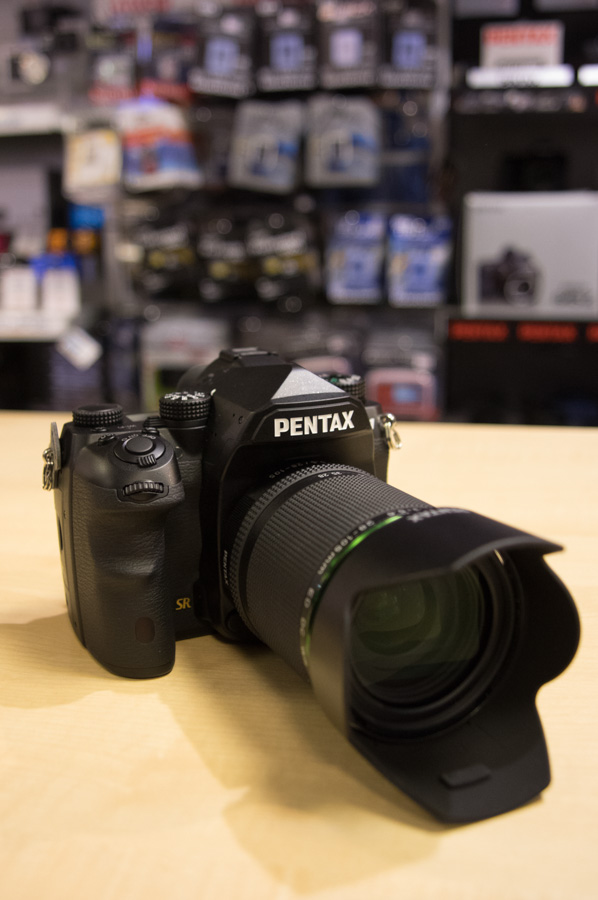 Pentax’s legacy spans back decades and I think it would be fair to assume than many older photographers will have used at least one of their cameras at some point in their career. My brother has used their film SLR’s for three decades and recently moved to their digital products. Ethan, once a keen user of the Olympus Four Thirds system, migrated to Pentax and now uses K-5 and K-3 bodies along with some pretty darn nice ‘Limited’ lenses. As for me, back in 1982, I was geared up to purchase a MX but the Olympus OM system proved too seductive and I travelled down that particular road.
‘Full Frame’ is a really odd term and one that does not sit easily with me. It refers to the sensor size - 36x24mm which are the dimensions of a 35mm film frame. The 35mm film standard evolved from the need to make more portable cameras – a move away from costly (and heavy) large format models that were the preserve of professionals at the time. The format can be traced back to Oskar Barnack who, through Leitz (now Leica), brought the first models to the world in the 1920’s. Therefore 35 mm was never ‘full frame’ but born out of the need for a compact format…essentially ‘part frame’. But it appears that the term ‘full frame’ will be the one associated with the 36x24mm format despite any inaccuracies.
More and more manufacturers are offering cameras that sport 36x24mm sensors. Not only do they offer higher resolution and less noise, but their cost has reduced significantly in recent years. We are beginning to see this size sensor in fixed lens bodies now, a la Leica’s ‘Q’ offering…interesting times indeed. But Pentax’s recent announcement of their intention to enter this market sector, via the K-1, is exciting stuff indeed. Why should this be so exciting…after all, they could be considered late comers to the game? Well what we have here is a fully weather sealed body, with a high specification at much less cost than that of the competition. Couple this with compatibility for their legendary ‘Limited’ series of lenses and older K-Mount lenses and what is there not to like? OK, the lens range is not as comprehensive as Nikon or Canon but I envisage the lens road map expanding if the K-1 is a success. In fact, we are already seeing movement in this area with the announcement of weather resistant 15-30 f2.8 and 28-105 f3.5-5.6 optics intended for full-frame bodies. Pentax appear to march to their own tune, irrespective of their Hoya or Ricoh owners and I get the feeling that the K-1 has not necessarily been brought to market to attract customers away from other brands, but also targets existing loyal Pentax users requiring an upgrade path to larger sensor photography.
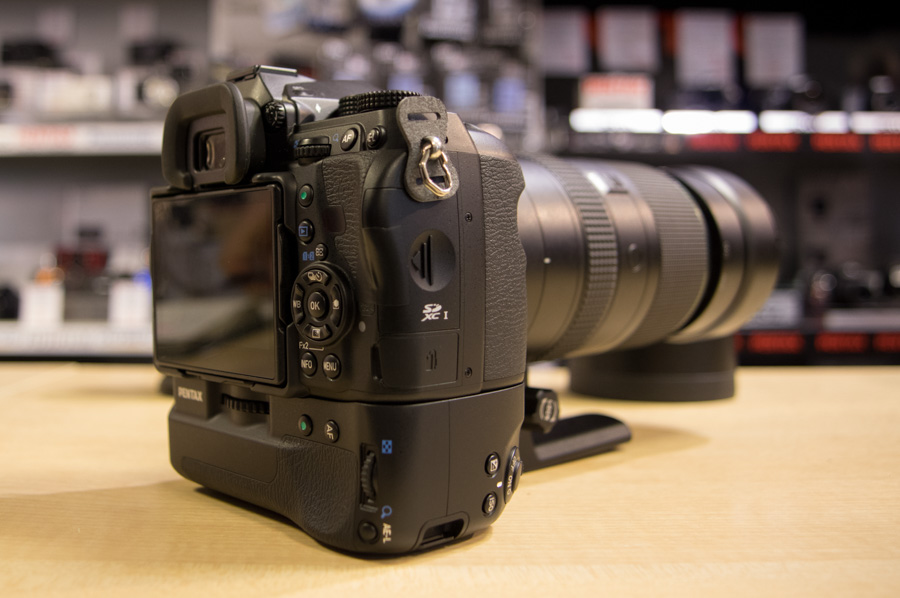 Hoping to get our hands on a working K-1 at the forthcoming NEC Photography Show, we were very excited when, prior to this, an opportunity arose to attend an event courtesy of SRS Microsystems in Watford. We have a list of questions about the camera that stretches on and on, and a particular interest in finding out how well the ‘Limited’ lens series perform wide open, so we wasted no time driving to the event.
3 out of 6 pre-production bodies currently in Europe were made available, all of which were running pre release firmware versions. This meant that we were not allowed to take any images using our own memory cards. Any images taken had to be left behind. This was a little disappointing as we hoped to include some sample images with this article. This did not deter us from taking lots of images of the camera for comparison purposes.
On picking up the K-1 we were immediately surprised by two things; 1. the size of the body was not as big as anticipated. We expected a supersize K-3 but in reality it was not much larger than other premium grade K bodies. 2. its weight was less than expected. This is not to say that it was light, but compared to a K-3, there was not a significant increase.
Build quality was what we have come to expect from Pentax. It felt very rugged, dials well damped and buttons very positive. As alluded to earlier, the body benefits from full weather sealing and if it is at least as good as its sibling models there should be nothing to worry about here. Talking to professional photographers who also attended the event, we were regaled by tales of K-3’s and lenses being dunked in the Thames to no detrimental effect. It would be fair to assume the same degree of water resistance in the K-1. It was also comforting to know that it shared the same battery as earlier models, so any spares purchased during the lifetime of the K-3 and K-5 before it are compatible.
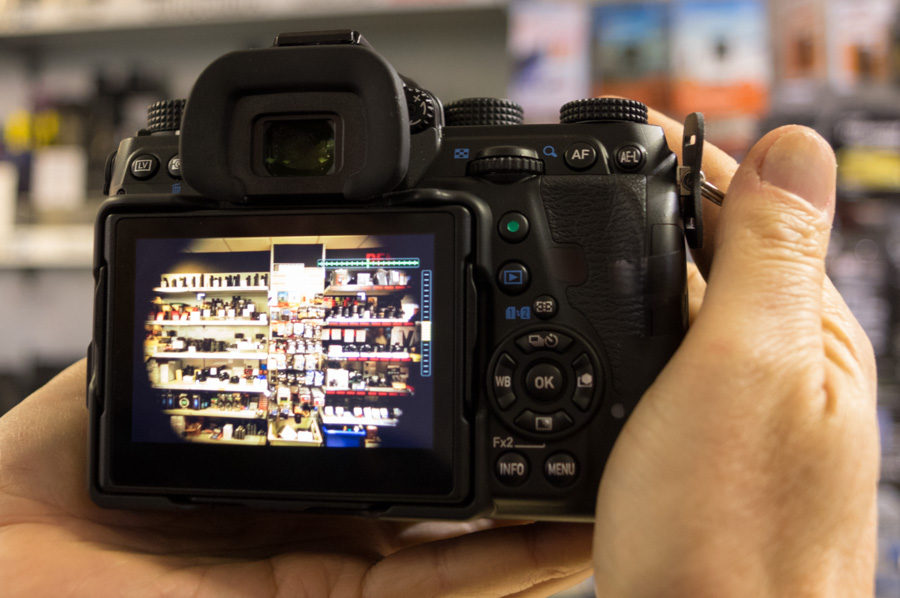
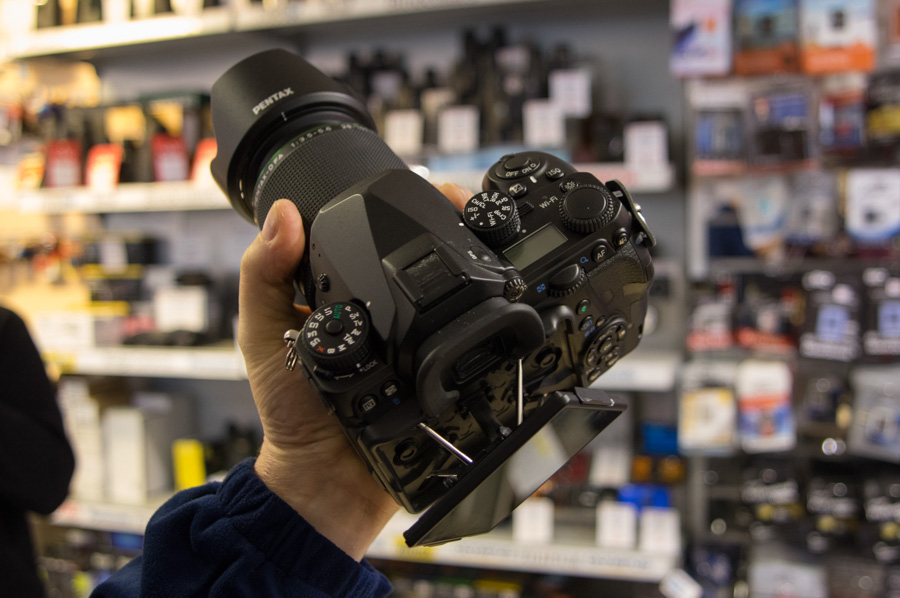 Anyone already experienced with Pentax DSLR’s will be very familiar with the design and layout of the K-1. We were able to pick it up and shoot test images with no hesitation, although a delve through the menus revealed quite a few changes. The tilting rear LCD panel has been engineered in a very different way to those found on other brands. Forsaking traditional hinge-style technology Pentax have adopted a novel approach by using four steel ball head rods connecting the screen to the rear of the camera. These allow tilting left, right, up and down with great fluidity, although do not allow the screen to be reversed or front facing (no selfies :-)). For those who are sceptical about the robustness of this design, we witnessed the camera being swung about by its screen to no tragic effect! I would not like to try this with a typical hinge design.
Looking through the viewfinder, it was reassuring to see a beautiful bright large image thanks to the use of a true glass prism. We expected the prism hump to be larger than it is…I recall when Olympus released their E3 and 5 cameras many years ago and thinking how disproportionally large their prisms seemed to be, particularly for a smaller format system. Not so with the K-1, it echoes the external design found with their larger format cameras without the bulk.
The K-1, we are told, is compatible with all K mount lenses so in theory this means that any lenses purchased back in the film era can be mounted, giving the same angle of view as what they were originally designed for. It would be fair to assume that some glass will not perform as well with a high resolution sensor when compared to their original film purpose, but the fact that they can be used allows for a huge amount of experimentation. Many film era K-mount lenses are also inexpensive today and I wonder if the release of the K-1 will see prices climb.
 After trying the body with the latest 15-30 f2.8 and 28-105 f3.5-5.6 lenses announced before the arrival of the K-1 (which appeared to perform very, very well incidentally), we were keen to try out some of the ‘Limited’ range, in particular those that Ethan has collected recently. It was at this point we realised that the word ‘compatible’ should be treated with caution here. The word seems a bit nebulous as during the presentation our attention was drawn to a list of lenses that Pentax claimed offered the best experience. But there are exceptions; Those lenses designed for the APS-C format (read other K series models) do work fine and the K-1 will display a cropped area on the rear LCD showing the useable part of the image. Some lenses, including a few of the ‘limited’ series should be stopped down one or two stops to achieve best performance.
We decided to put this to the test and attached Ethan’s 15mm f4. Looking through the viewfinder it was immediately apparent that this was not a good combination as vignetting in full frame mode produced an obvious circular image. Stopping the lens down to f16 did not really help…images still appeared almost circular. This was a bit disappointing as it means that the 15mm can only be used in cropped mode, resulting in much smaller images.
Next up was the beautiful 20-40mm zoom, a particular favourite optic of ours. I thought that with this being less wide that the 15mm, vignetting would not be apparent. Disappointment again I’m afraid as there is significant vignetting at the 20mm end, though it has gone by 25mm. This I guess means that it is semi useable as a full frame lens at its longer focal lengths only. Switching to cropped mode resolves this, again at the expense of resolution.
We are really hoping that Ricoh/Pentax will reformulate these lenses in the future and make them truly compatible, athough I expect their size will increase significantly.
We then tried the 77mm f1.8 which, it is claimed, works very well. This is not a lens that we own, but the team at SRS kindly allowed us use of theirs. As claimed, the 77mm works extremely well. Even wide open the pictures it produced were very sharp edge to edge and showed little if no colour fringing. We shot a whole series of images and could not fault this combination of camera and lens…so much so it has made its way onto our lens short list…it is nothing short of stunning.
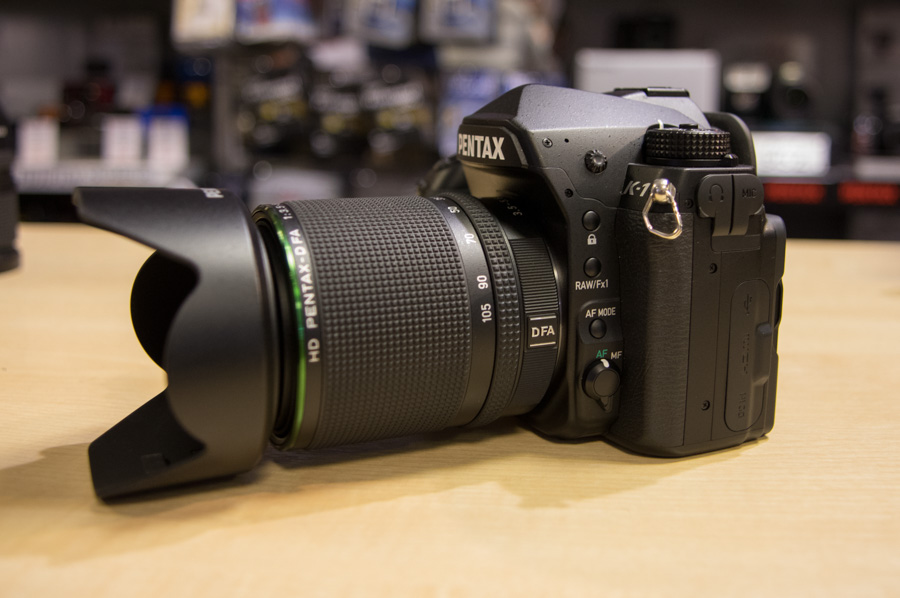 It was our intention to also try the 31 and 43mm limited lenses as they allegedly perform similarly to the 77mm. However these were not available on the day. Maybe this is a test we can continue at the upcoming photography show next month if a full lens line up is present. I am keen to see how these lenses perform wide open as I am currently doing market research into purchasing a full frame DSLR with a small collection of high performance primes. The 31, 43 and 77 appear on paper to be my holy trinity of lenses. Given how the K-1/77 combination looks, handles and performs, it has found itself at the top of my potential purchase list.
Shipment of K-1’s is set to commence in April and we do not see why this should not be a huge success for Pentax. It has been a long time coming but feel that it is well worth the wait. The camera feels mature and up to the task of producing stunning images in the harshest of climates. Time will tell I guess and we are going to be following its early days with much interest.
Our thanks must go to the team at SRS for arranging and hosting the event. Not only did they provide this sneak preview of a much anticipated camera but also staged two very interesting presentations from two very talented Pentax Ambassador photographers. Stewart showcased some of his fascinating street photography which really struck a chord, especially those images of the homeless. One in particular will stay with me for a very long time - very powerful stuff.
Matt gave us a glimpse into the incredible world of the Urbanex photography. We are no strangers to this kind of work but his presentation took this to a whole new level and we fully appreciate that results like this are produced with a certain nerve, personal risk and excellent compositional skill.
Thank you gents for contributing to a superb day.
Images