Introduction and Background
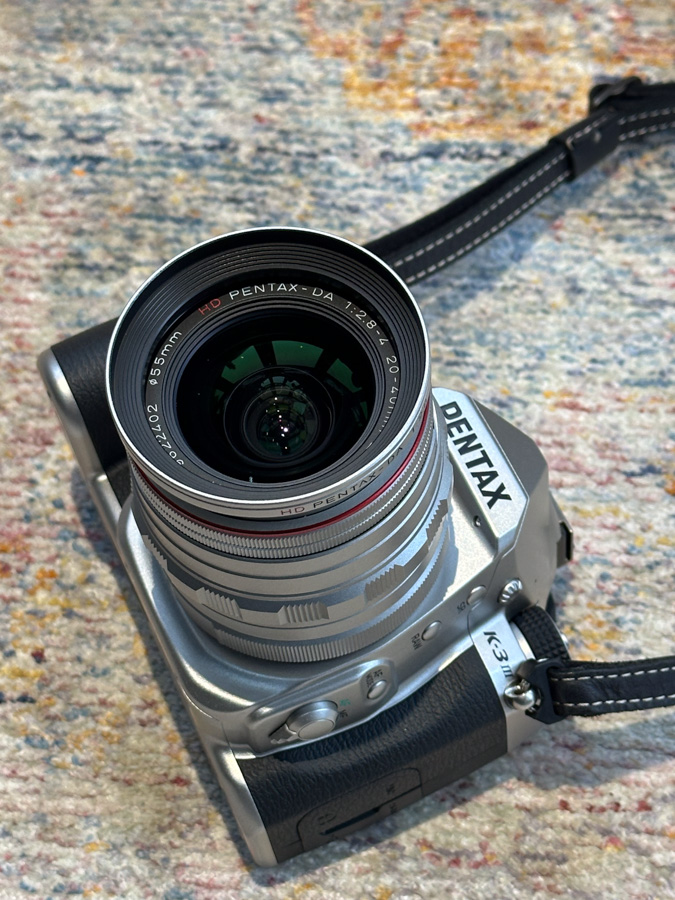 In today’s age of mirrorless cameras, DSLR’s have become something of a dying breed and defined on the whole by mature examples provided by Nikon, Canon and Pentax. It appears to be the latter of these three brands who have taken on the task of creating a niche for themselves by shunning mirrorless technology in favour of the DSLR. While Nikon and Canon maintain a foothold in the space, they do so with products that are several years old. Pentax, however, have reiterated that they remain committed to DSLR (Digital Single Lens Reflex) style cameras and continue to push the boundaries on very mature products.
Pentax’s space in the camera market has shrunk significantly over the last couple of decades. Gone are the days when several models could be found in most camera stores. No longer an independent company, they are currently part of Ricoh Imaging who seem intent on preserving Pentax’s legacy. Unlike most other brands they march to a tune not dissimilar to Leica. Compared to others, there isn’t a relentless slew of new models falsely convincing a user of the need to continuously upgrade. But in the last couple of years there is no denying the slow down in new products coming to market - something that makes some long standing Pentaxians a little nervous. I am not sure if this is a genuine problem or simply a perception amplified by the product churn of other brands. After all, a six year old K1 mkii is as good now as it was when it was released. Of course technology moves on, but technical evolution has slowed considerably with much hype now placed on faster startup times, faster autofocus, better noise reduction etc. Even the megapixel race has finally slowed down with users beginning to appreciate that less can be more.
I am fairly confident that a K1 mkiii will appear when Pentax are confident there are enough component upgrades to justify bringing a new iteration to market. Consider the timeline of the K3; the original model was released in October 2013. Its successor followed less than two years later. The models are very similar in both looks and technical specs - differences being more of an incremental nature than revolutionary ‘break-throughs’. Fundamentally it is this very business model that most other brands are still using today. However it was another six years before the mkiii appeared. But this heralded in a very different camera. This was not a warmed over update that added little to the users experience. Setting down our K3 Prestige and K3 mkiii in front of me, the physical differences are many while still sharing obvious DNA traits that the K3 line is known for. Under the hood, almost everything has been improved. It is not the purpose of these words to delve into every change… there are some excellent resources on-line that deal with this. But there are a few standout changes that I will touch on below. It is suffice to write that with the K3 mkiii, Pentax have given us a genuine upgrade that easily justifies its cost.
Optical Viewfinder
My family have been Pentax users since 1983. While I have never owned one until earlier this year I have gained access to various film and digital models, allowing me first-hand experience of this venerable brand. Because of this, it became a natural choice when I decided to build a second system. A silver K3 mkiii was to be my first body as this was the most up to date model. I was very curious to return to an optical viewfinder after spending years looking though EVF’s of varying quality. Up until this point the brightest optical finder I had used was my Olympus OM3Ti film camera that used a very bright 2-13 series focus screen. When used with a Zuiko 50mm f1.2 lens, the image was really something - incredibly bright and contrasty. I could use this to manual focus at night time with complete confidence. To find that the prism and screen of the K3 mkiii delivered an even brighter experience - even with slower f2.8 lenses - was a revelation. The difference is also noticeable when comparing it to the original K3. The long gestation period of the mkiii was, in my opinion, worth the wait for this alone. Pentax should be commended for pushing the boundaries of what is possible with high grade optical prism glass. For additional comparison I picked up my 40 year old OM1n with 50mm f1.8 lens. I recall the time all those years ago when I thought this was bright when comparing it to an even older Zenit. There is simply no contest between OM1n and K3 mkiii which is indicative of how far things have come in this field in four decades.
Autofocus and Image Stabilisation
 I have read a lot of criticism regarding autofocus speed of Pentax camera’s. While it has improved significantly in this latest model, many feel there is still room for improvement. Critique comes from those operating in genres of photography such as wildlife and sport, where split second timing is the difference between success and failure. As I do not work in these areas, I have no first-hand experience of the frustration this causes. However, from many comments I have read regarding this, it is easy to understand why some other brands tempt Pentax users away. This aside, autofocus speed should not be confused with autofocus accuracy, and I have found this to be more than adequate so long as each lens has been calibrated correctly. I cannot emphasise how important carrying out this task is, especially with fast lenses such as the DFA* 50 and 85mm f1.4 lenses. Prior to doing this, I could not obtain critical focus when using either lens wide open. Similarly, when attaching Ethan’s 31mm Limited lens, it was very soft wide open. Calibrating this to +7 improved things considerably.
The mk iii’s autofocus module is a significant step up from previous versions. We now have 101 focus points - more than enough for my purposes. However, I am surprised to find that only 41 of these are selectable by the user. I would probably be satisfied with this if they were not arranged with a bias toward the centre of the focus screen. It is not possible to use the joystick to select an area at the periphery, which means that some compositions require the user to use ‘focus and reframe’ methodology. In many instances this works fine but becomes a hit and miss affair if using a very fast lens such as the DFA* 85mm f1.4 wide open, due to its very shallow depth of field.
Believe it or not, I am a relative newcomer to Image Stabilisation. Whether built into the lens or camera body, the technology is very mature across most brands. My photographic interest goes back more than fifty years and it is only in the last two that I have owned gear that features this. The K3 mkiii is the third camera in my collection to have stabilisation (the others being a Leica Q2 and SL2-s). Although I have not tested Ethan’s original K3 and the mkiii side by side, I understand the stabilisation of the latter to have improved. To be honest, we have found the original K3 performs very well so any improvements are a bonus yet to be appreciated. As the mkiii excels at higher ISO’s I have found I bump this more often than selecting slow shutter speeds.
Weather Resistance
If there is one truly excellent point that Pentax DSLR’s have been singled out for, it is the quality of the weather sealing. Even back in the K5 and K7 days it was legendary and a quick search on the web will return some pretty impressive stress tests. I am not sure if this has improved much in the mkiii over previous K3 iterations, but it is good to know that it can take some serious abuse, assuming a similarly protected lens is attached. The ability to use a camera in severe weather conditions without worrying about the electronics allows a photographer to concentrate wholly on the image being captured. While I have little experience of deliberately working in inclement weather conditions, I have encountered many instances of very changeable and sometimes dangerous conditions that have unexpectedly caught me out. I have every confidence that this latest generation of K3 deploys some of the finest weather sealing available.
Build Quality, Handling and Grips
 There is no denying that, like all iterations of the K3, this latest version feels solid. Nothing creaks or bends. Image Stabilisation aside, nothing rattles or vibrates. It is a very robust and well constructed body. Its density makes me feel confident that it will stand up to many years of use. Ethan’s beautiful gunmetal ‘Prestige’ version of the K3 is just over 10 years old and feels as solid as the day he took it out of the box. Nothing has become loose, fallen off or worn and functionally, it is flawless. I think that part of the K3 series strength comes from it not having a movable rear screen. The mkiii has been criticised for lacking this but it is not something that bothers me; I have yet to own a camera with a tilting screen and the only concession I have in this area is Leica’s detachable Visoflex electronic viewfinder I use on the T series cameras - this tilts through 90 degrees.
With a DA prime or the 20-40 zoom lens attached, the weight and balance of the camera feels perfect to me. It is only when attaching larger lenses such as the DFA* 50mm f1.4 that things become a little ungainly. Attaching the DFA* 85mm f1.4 amplifies this although not to the point of making it totally unwieldy. I have toted this combo around for a few days and it can feel cumbersome, depending on whether it is slung over a shoulder or around the neck. It can be mitigated by using a wide well-padded strap. I am guessing use of the DFA* 70-200mm or DFA 150-450mm zooms would exasperate the situation, but we have to remember that all DFA lenses are intended for use on the larger K1 series bodies and possibly with an additional grip.
Our collection of cameras vary considerably in their handling and design philosophies. Our Pentax models are what could be considered the most traditional. A large part of this is their grip which is absent from many of our Leica bodies. The K3 grip is very ergonomic and has gone through only minor revisions as bodies have evolved. I have large hands and many of our Leica’s require me to either add an optional thumb grip or use a case to ensure my sausage-like fingers have a secure grasp. I could be forgiven for thinking that the designers of the K3 had customised the grip specifically for me. It feels perfect in every way, from the way my fingers settle into the contours, to its size and materials used. If I drop this camera it will be through no fault of the design. Comparing it to my Leica SL2-s grip, the contouring of the K3 feels vastly superior to me and far less ‘generic’. I feel that Pentax have put considerable effort into getting this right. Its comfort is to some degree limited by the lens attached to the camera and while we do not have anything like the larger DFA* 70-200 or DFA 140-450 zooms, it makes using the hefty DFA* 85mm f1.4 far less of a beast to deal with. It feels particularly natural when using the Limited 20-40mm zoom.
Menu
I love simple menus and it is one of the contributing factors to me continuing to use Leica cameras. It was inevitable that selecting a second system would bring menu complexity back into play and I would simply need to accept that.
One of the biggest changes between the first K3 and its mk iii counterpart is the menu. Comparing the two, it is clear that Pentax have put considerable effort into making navigation as logical as possible in this latest iteration. It's not that previous menus were poorly executed, but they do look a little dated and some items take a deeper dive to change. Some options are still buried unavoidably deep but on the whole I am getting used to it. A small point I have found rewarding is the ability to change the menu font colour. A grey background with white text complements the camera’s black and silver finish and allows me a little more customisation.
Buttons, Switches, Dials and Warts
 If I had to call the designers out on one thing about the camera design it would be the amount of direct access buttons. It is clear that their inclusion addresses requests and feedback from the user base. But in attempting to be all things to all people, I call into question the usefulness of some. From all I read in forums and reviews about cameras in general, I get the impression that I fall into a minority when it comes to button usage.
Now that touch screen technology has matured I find it much simpler (and cleaner) to use this to select many ‘on the fly’ changes. It is this simplicity that drew me to Leica’s T series cameras several years ago. Setting one of these and a K3 down side by side, they could not look more different. The K3 is pretty much covered in an acned rash of switches, dials and buttons, as well as offering limited touch screen interaction. Button enthusiasts argue that it is simpler to press a button to make a change. But having set up several of my cameras to exploit the touch screen interface I have found that, during comparisons there is very little difference. In my opinion a simple list of ‘favourites’ to select from a main shooting menu is very quick and decisive to use. As it stands, I often mistakenly press one of the many buttons when simply handling the camera, especially if I am trying to work quickly. In my mind, buttons are very old school, addressing a method of working that feels somewhat clunky and outdated since the advent of touch screens.
Buttons such as RAW, SR and AF Mode leave me scratching my head a bit. As does the AF/MF switch, along with the top plate dial that allows selection of Live View and Video mode…really? Rationalising these would make the camera’s use much more user friendly and improve handling. If I dare suggest that Pentax takes a leaf out of Leica’s design philosophy, I would leave all remaining buttons unlabelled al la SL/TL/CL/Q series as it causes far less confusion when reassigning their functionality. It feels a bit of a fudge remembering, for example, a remapped ISO button carrying out a different task. Taking the design a little further into outrageous territory, I would be curious to see a prototype K3 (mk iv) devoid of all except three or four buttons with a maximum of two rotating dials (excluding shutter). All could be configured with primary functions and all else accessed by touch screen (dream on :-)).
Coming back down to earth, and acne aside, the K3 series cameras are very good looking, ergonomic and excellently proportioned.
Output
Of course looks do not make for an excellent shooting experience alone. They work in symbiosis with internal hardware to produce results that Pentax have long been applauded for. The changes that came with the K3 mkiii continue this trend and are the guiding star for further enhancement. JPG output is not something I use, but those that do are very happy with the accurate rendering and low noise, even at higher ISO values. For me, DNG files are beautiful to work with and require very little in post production to give me satisfactory results. An incredible amount of information can be teased from under or over exposed areas with minimal noise penalties. What this does demonstrate is that an APSC format sensor is far from inferior to larger counterparts, and more than acceptable for producing large prints.
Product Cycle
I think it would be an understatement to write that Pentax’s product cycles are lengthy. And it seems that periods between new models is widening as the years go by. But in the digital era Pentax has never danced to the tune of constantly churning out “updated” models and surrounding them with marketing hyperbole. It has become fairly standard Pentax operating practise for new releases to take several years to materialise. This ensures that a new release contains real value, ergo justification in abundance of to go out and buy it. As far as I am concerned, I am happy with seven or eight year product cycles when it comes to camera bodies. All I ask is that the brand produces roadmaps and occasional updates so that the dedicated user base knows the lights are still on. Without these, speculation inevitably falls on the negative side which can only be detrimental to a much-loved and respected member of the photo industry.
The K3 mkiii is a solid refinement of the K3 series and one I feel should be around for several years to come. The fact that there is also a Monochrom version highlights its success. With this model, I am convinced there is a future for DSLR’s and will be expanding my Pentax system in the months to come.