In July 2023, we embarked on an 18 night trip around Greece’s Thessaly region. It was a trip originally planned many years ago but deferred in favour of a trip to Corfu and Paxos. We then scheduled it in for 2020 but travel restrictions imposed by the Coronavirus pandemic meant we had to defer it again. In July it was a case of third time lucky that nearly met with abandonment three days into the trip due to one of our Macaw parrots escaping back home. However, his recapture 24 hours later allowed us to continue the trip.
The starting point for the trip was Thessaloniki. From here our overnight stopping off points were Kastraki, Kala Nera, Litochoro and finally back to Thessaloniki. This allowed us to explore many sights in the region that, taken individually would have been longs drives from a single base.
As much as I would have liked to take my Leica SL2-S and a few of my SL lenses, it was simply too large and heavy to lug around on such a journey. My recently acquired Q2 Ghost would have limited my options too much so this, too, stayed at home. My original T and TL2 with 11-23, 35 and 55-135 were selected to join me, as they provide a lot of flexibility without the weight of the SL system.
-

Thessaloniki; One of our favourite Greek cities and the starting point for a few previous journeys. Like many Mediterranean cities, it is vibrant, bustling, historical and hot. That it is home to the Aristotle University gives it a young and energetic vibe that really makes it come alive. It is very easy to while away a few days here not only visiting the sights, but spending time ensconced in a cafe accompanied by a Freddo Cappuccino, watching the world go by.
-

One of the sights we have missed on previous visits to Thessaloniki is the Rotunda and Arch commissioned by the 4th century Roman Emperor Galerius. Just a couple of sections of the Arch remains but it is still an imposing sight and offers shady respite from the hot sun. The Rotunda is a much more complete structure having seen continual use throughout the ages. Originally built as a mausoleum for Galerius (but never used by him for this purpose) it became a Christian Church, followed by a Mosque whereby it gained a minaret. It was reverted back to a Christian church in later times.
-

Close study of the interior of the Rotunda reveals many different building phases and architectural designs.
-

The city rooftops are a bristling field of antennae and satellite dishes, highlighting our thirst for communication.
-

The first of many bottles of Retsina we drank during the trip.
-

From Thessaloniki we drove west to the modern village of Pella which, in ancient times, was the seat of power for the Macedonian empire. The museum houses artefacts from the ancient city as well as finds from surrounding villages, such as this Hellenistic copy of a bust of Alexander the Great.
-

A golden diadem found in a grave in the ancient city. This example, like many others in Thessaloniki and Vergina museums is stunning in its detail.
-

A general view of the enormous agora of Pella, the largest of its kind. Foundations of shops are clearly visible around its external sides, while the internal sides have many remnants of columns that once supported a shady portico. Walking the site in 37C it was easy to image how beneficial any shady areas would have been.
-

After a lunch of Briam and Stuffed Peppers, we picked our way through the countryside and joined the A2 motorway before turning onto a very scenic road to Kalabaka. The afternoon was humid and sultry, making this stop at a clear flowing river a welcome break from the road.
-

After another hours drive, we reached Kalabaka and headed to the smaller village of Kastraki where we checked into our hotel for the next few days. Kastraki is very well located for visiting the Holy Monasteries of Meteora, as this picture of the Saint Nicholas Anapafsas monastery taken from our hotel balcony shows.
-

The area of Meteora is truly stunning, a place where landscape, nature and faith collide to produce a vision of something quite unique. It has, however, been on the tourist trail for many decades and tour buses wind their way up to and down the roads disgorging hundreds of people outside many of the monasteries, thus shattering the air of calm and peace. Following some of the walking trails was a much better experience to driving, as we could take in the local wildlife and admire views in peace. By far the best experience is in the evening, after most people had left. To sit on one of the high rock outcrops at sundown, overlooking the villages way below was very spiritual.
-

View over Meteora at sundown, enhanced by a cool glass of Retsina.
-

A stunning location for wedding photographs.
-

The Holy Monastery of Varlaam. We walked from Kastraki along a well defined woodland path which brought us out here.
-

A couple of hours drive from Kastraki brought us to the port of Volos, from where we took the Ring Road onto the Pelion Peninsula. After another 45 minutes we reached our next destination, the small village of Kala Nera, and a refreshing Freddo Cappuccino.
-

A close-up study of one of the abandoned old houses.
-

Kala Nera waterfront; a sleepy little village in the late afternoon where trees overhung the sea.
-

One of several coastal walks we did around Kala Nera.
-

As the trees came down to the sea in many places along the Pelion coast, it was inevitable we would come across one that had toppled into the water.
-

A large house, literally a few feet away from the water’s edge.
-

A rather benign looking deserted house on the outskirts of Kala Nera. It took on a more sinister appearance after dark as the area was unlit and accompanied by the noises of several nocturnal creatures.
-

The previous few days had seen the temperature gradually climb from mid 30’s C to mid 40’s. Weather warnings had been issued recommending that people stay indoors during early afternoon. We decided to drive into the mountains to explore the village of Milies. We were very much mistaken thinking it would be cooler here as the temperature soared to 49C. It made walking around exhausting.
-

As it was so hot, we decided to walk a few miles along the old narrow gauge railway as there were no steep inclines and the cuttings gave us some shade. Trains only run at weekends so as this was a weekday, we had the railway line to ourselves.
-

Where the railway did leave the forest, it gave spectacular views of the coast.
-

The quaint little railway station at Milies. Shame all train seats were fully booked during our stay.
-

This sign pointed the way to a much needed taverna where we could slake our thirst.
-

I admit to having a soft spot when it comes to photographing decaying woodwork such as this door.
-

The sleepy little village of Chorto, an idyllic place we stopped off at on a drive the the southern most part of the Pelion Peninsular.
-

A place where pine trees meet the sea.
-

The hilltop village of Trikeri is the furthermost settlement of any size on the Pelion Peninsula and even though the distance was only around 60 kilometres, the winding roads make it about a two hour drive. It is a beautiful place and was very quiet when we arrived early in the afternoon.
-

A view over the rooftops of Trikeri from the Church of the Holy Trinity.
-

The seaside village of Kato Gatzea was just a couple of kilometres’ walk from our lodgings in Kala Nera. It made a nice coastal stroll for a coffee on more than one occasion.
-

Karla Nera. We were spoilt for choice when it came to finding somewhere to eat in the evenings. Food served here was typically Greek and of an excellent standard.
-

Kala Nera.
-

As the port of Volos was just a 45 minute drive away, we spent a couple of days shopping and exploring here. It is very much a working port city and a departure/arrival point for dozens of ferries to different parts of the mainland and many of the islands.
-

The waterfront of Volos is a long line of cafes and tavernas.
-
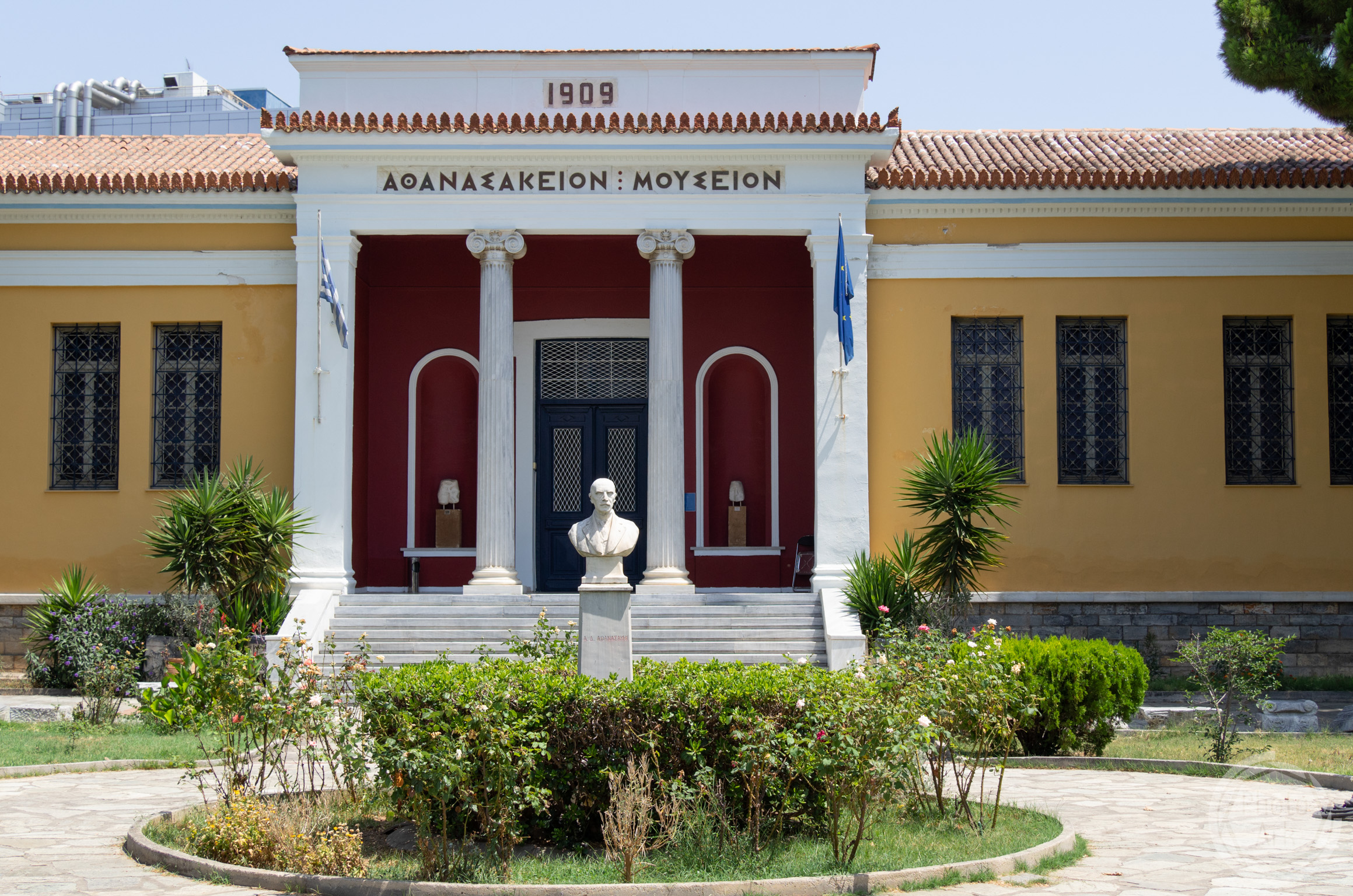
Archaeological Museum of Volos. Apart from containing some excellent artefacts, it was a great place to escape the midday heat for a couple of hours.
-

What I found particularly fascinating was a collection of ancient painted tombstones that have been found in and around the city. That they still had most of the paint present after more than two millennia was incredible. The detail still present belies the fact that in ancient times, it was a less expensive option to have a headstone painted than it was for an engraved or carved version.
-

A very well preserved headstone.
-

This tombstone contained a very poignant obituary which read; “Antigenes Sotimo’s son. Minos just sent me, Antigenes, to the islands of happy people, as I had got fatal wounds on the head and my body was pricked from spears, at the moment the goddess of war encouraged me during the infantry battle against the Aitolians. My family, the old among Magnates and my blissful homeland, the town of Demetrias and my mother Soso, didn’t cry for me, the true-born son of Sotimo’s.
I didn’t go against the enemies having a female soul, but while I was saving the company of adolescents - who know well what I’m talking about - and I was fighting for Zeus (Akraios) and for my arming combative flute and I was defending the memory of Alexander the Great, whose the courage was plenty, I covered with my body the land of Phthiotic Thebes.”
It is moments like this that history’s time-worn fingers reach out to the reader.
-

Holy Metropolitan Church of Saint Nicholas.
-

A drive to the mountain village of Tsagkarada rewarded us with stunning scenery and a chance to refresh ourselves beneath the village plane tree which is reported to be over a thousand years old.
-

Interior of Agia Paraskevi church, Tsagkarada, and a candle lit in memory of our recently deceased loved ones.
-

After nine nights spent on the Pelion Peninsula, we picked up the A1 motorway and headed north for a three night stay in the mountain town of Litochoro. One of the gateways to Mount Olympus, there are several walking trails that start here, some of which lead to the summit. Temperatures were still in the low 40’s when we arrived, curtailing our plans to take on any long walks.
-

A glimpse of Mount Olympus from Litochoro’s shady park.
-

Early evening view of Litochoro, after the tour buses had departed.
-

The tower of the Holy Church of Saint Nicholas, Litichoro.
-

A walk which we did manage to complete was a fairly shady route along the Enipeus Canyon. The path was fairly flat and followed the river Enipeus for a few kilometers. From this route a couple of high altitude paths headed in the general direction of the summit. While we would have loved to have explored these, temperatures were simply too hot and the risk of heat stroke was very real.
-

No trip to Greece would be complete without a visit to a nearby castle. This one, a few miles from Litochoro, on the outskirts of Neos Panteleimon is a beautifully preserved example of a Crusader Castle. Temperatures again hit 49C on the day we visited this, and we scuttled around from one shady area to another like vampires. Having seen all of the interesting bits of architecture, we beat a retreat back to the coast…
-

…but not before capturing a stunning image from the castle walls looking North along the coast.
-

High on the visit of places to visit was Dion Archaeological Park. After checking out of our hotel in Litochoro we headed here for a few hours. As the name suggests, the site has been laid out in the style of a park, with benches and trails that lead to the various sanctuaries. This image of the possible location of the Sacred Grove of the Muses gives the illusion of a cool place to rest. However, our clothes clung to us with sweat from simply walking from the admission kiosk to this spot, just a few meters away.
-

One of the main streets that ran through Dion, connecting the sanctuaries with the agora and houses. This shot shows the rutted road surface caused by centuries of long vanished traffic.
-

Unlike many parts of Dion that have replica statues on display, there is not much left to see of the Sanctuary of Olympian Zeus. Not to be confused with the more evocative Sanctuary of Zeus Hypsistos at the northern end of the site, it is know that both Phillip II and Alexander the Great visited and sacrificed at the Sanctuary of Olympian Zeus. It was humbling to be able to stand in the same place as such illustrious leaders, separated by nothing more that time. Mount Olympus dominates the background of the sanctuary in this image.
-

The Sanctuary of Isis, now partially submerged or waterlogged since seismic activity contributed to Dion’s decline in the third century AD, feels like a piece of Eden. The area is verdant and alive with Dragonflies, Damselflies, frogs and many species of birds.
-

Our last night was spent back in Thessaloniki as it began, with a chilled glass of Retsina.